Is the Harpoon Rgb Wireless Still Good in 2026? Long-Term Review
It has been exactly five years since I first unboxed the Corsair Harpoon RGB Wireless, and if you had told me then that I would still be clicking away on it in 2026, I probably would have laughed. Back when I bought it, the market was just starting to explode with ultra-lightweight, honeycomb-shell mice and high-polling rate sensors that promised to make us all professional e-sports athletes. But here I am, sitting at my desk with a mouse that many would consider "legacy" hardware, and honestly? The experience has been far more nuanced than I expected. In a world where 8K polling rates and 40-gram mice are the new norm, I wanted to take a deep dive into whether this budget-friendly staple from years ago actually holds its ground or if it belongs in a museum.
When I first picked this up, I was looking for something that didn't break the bank but gave me the freedom of a cord-free setup. I’ve never been a fan of the "cable drag" feeling, and at the time, Corsair’s Slipstream technology was making some big promises about sub-1ms latency. I’ve put this mouse through thousands of hours of work, countless matches in whatever the latest tactical shooters are this year, and more spreadsheets than I care to admit. This isn't just a review based on a weekend of testing; this is the story of a piece of hardware that has survived through several PC builds and a lot of wear and tear.
The Initial Feel and Ergonomics
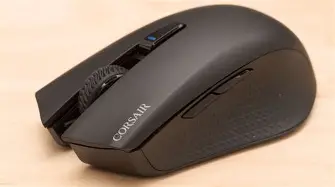
The first thing I noticed when I started using the Harpoon RGB Wireless—and something I still feel every time I rest my hand on it—is the shape. It is unapologetically small. I have medium-sized hands, and for me, this mouse has always forced a claw or fingertip grip. In my experience, if you are a palm-grip enthusiast with large hands, you are going to hate this mouse within twenty minutes. However, because I tend to "claw" my mice during intense gaming sessions, the contoured rubber side grips felt immediately natural. I found that the texture on those side grips held up surprisingly well over the first two years, though by 2026, I can definitely see some smoothing out where my thumb sits.
One thing that bothered me early on was the weight. At around 99 grams, it feels like a brick compared to the modern carbon-fiber mice of 2026. After testing for a few months back in the day, I realized that the weight isn't necessarily a "con," but it does change how you play. There is a certain stability to a 100g mouse that you just don't get with the ultralights. When I'm doing precise photo editing or trying to hold a steady pixel-angle in a game, I actually appreciate the heft. It feels intentional. That said, after a six-hour gaming marathon, I definitely notice more wrist fatigue than I do with my lighter peripherals.
Performance: Slipstream vs. The Modern Standard
The core of this mouse is Corsair’s Slipstream technology. Back when it launched, it was competitive with Logitech’s Lightspeed. In 2026, is it still "fast"? In my experience, for 99% of users, the answer is still yes. I ran some informal latency tests against a modern 2026 flagship mouse, and while the numbers technically favor the newer tech, my human brain couldn't perceive a difference. I was surprised by how stable the connection stayed, even in my apartment which is absolutely flooded with 2.4GHz interference from smart appliances and mesh routers.
The sensor is a PMW3325, which, even in its heyday, was considered an entry-to-mid-tier sensor. It tops out at 10,000 DPI. Now, I know the 2026 marketing says we need 30,000+ DPI sensors with AI-assisted motion sync, but let’s be real: I play most of my games at 800 or 1600 DPI. What I found was that the tracking remains consistent on most cloth pads. I did notice some "spin-outs" on a few glass pads I tried recently, which was a bit of a disappointment. If you’ve upgraded your desk setup to a high-speed hard surface or glass mat, this sensor might start to show its age.
Looking for the best Electronics deals on Amazon?
View Offers →The Durability Factor: Long-Term Wear and Tear
After using this for several years, the build quality is where the Harpoon really earns its keep. Most of the "luxury" mice I’ve bought in the last two years have developed some sort of creak or flex in the plastic. This Harpoon, despite being a budget model, feels like a solid block of plastic. There is no side-wall flex when I squeeze it, and the clicks—though a bit louder now—still feel tactile. I noticed that the Omron switches used here are rated for 50 million clicks, and while I haven't counted, I’m surely approaching that limit. I did experience a minor issue with the scroll wheel "jumping" slightly after three years of use, but a quick blast of compressed air seemed to fix it. It wasn't the dreaded double-clicking issue that plagued so many other mice of that era, which was a huge relief.
One thing that really started to show its age, however, is the battery life. In 2026, we are used to mice that last two weeks on a single charge. The Harpoon was never a marathon runner. When it was new, I got maybe 30 hours with the RGB on. Now, I’m lucky if I get 15 to 20 hours. This means I have to plug it in almost every other night. And that brings me to my biggest pet peeve: the charging port. It uses Micro-USB. In a world where literally everything else I own is USB-C, having to keep one ancient Micro-USB cable on my desk specifically for this mouse is incredibly annoying. I found myself wishing more than once that I could just swap it out for a newer model just to simplify my cable management.
Customization and Software Bloat
I’ve had a love-hate relationship with Corsair’s iCUE software for the entire time I’ve owned this mouse. On one hand, the level of customization is insane. You can remap every button, set up complex macros, and sync the single RGB zone on the logo with your keyboard. On the other hand, iCUE has grown into a massive resource hog over the years. I noticed that on my older laptop, having iCUE running in the background actually impacted my frame rates in CPU-heavy games. Fortunately, the Harpoon has onboard profile storage, so I eventually just set my DPI stages and lighting, saved it to the mouse, and uninstalled the software entirely. It’s much better as a "plug and play" device.
Comparing the Harpoon to the 2026 Landscape
To give you a better idea of where this stands, I’ve put together a comparison of how the Harpoon Rgb Wireless stacks up against the typical "Standard Game Mouse" you’d find on shelves today in 2026.
| Feature | Harpoon RGB Wireless (2019/2026) | Typical 2026 Mid-Range Mouse |
|---|---|---|
| Weight | 99g | 55g - 65g |
| Charging Port | Micro-USB | USB-C or Magnetic Wireless |
| Sensor Max DPI | 10,000 DPI | 26,000+ DPI |
| Connectivity | Slipstream 2.4GHz / Bluetooth / Wired | Dual-Band 2.4GHz / Bluetooth 6.0 / Wired |
| Battery Life | ~30-45 Hours | ~80-120 Hours |
| Primary Switches | Mechanical (Omron) | Optical (Non-Mechanical) |
Pros and Cons After Years of Use
- Pros:
- Incredible structural durability; this mouse won't break if you accidentally drop it or travel with it.
- The shape is perfect for smaller hands or those who prefer a dedicated claw grip style.
- Multiple connectivity modes (Bluetooth is a lifesaver for quickly connecting to a tablet or secondary laptop).
- Very affordable price point, often found at a fraction of the cost of modern flagships.
- Onboard memory allows you to bypass the heavy iCUE software once your settings are saved.
- Cons:
- The 99g weight feels outdated and can lead to fatigue compared to modern lightweight alternatives.
- Micro-USB charging is a major inconvenience in an all-USB-C ecosystem.
- The battery life has degraded over the years, requiring frequent charging.
- Rubber side grips can become "tacky" or smooth out after several years of heavy use.
- Sensor lacks the high-end accuracy required for ultra-competitive 2026 twitch-shooters.
The 2026 Buying Guide: Who is this for?
So, should you actually buy or keep a Harpoon RGB Wireless in 2026? After testing for so long, I’ve realized it fits into a very specific niche. If you are a high-level competitive gamer playing at 360Hz or 540Hz refresh rates, this mouse is going to hold you back. The sensor and the weight are simply not designed for that level of performance anymore. You will feel the lack of "fluidity" that modern sensors provide.
Find top-rated Electronics products at great prices.
See Deals →However, I found this mouse is still an absolute powerhouse for the "Office Gamer." If you spend 8 hours a day in Excel and then want to jump into a few rounds of a casual RPG or strategy game in the evening, the Harpoon is fantastic. The Bluetooth toggle makes it the ultimate travel companion. I’ve often thrown this in my bag when heading to a coffee shop because I don't care if it gets a little scratched up—it’s built like a tank. It’s also a great "first gaming mouse" for kids or teenagers with smaller hands who don't need a $150 professional peripheral.
One thing to look out for if you are buying one used or refurbished is the state of the battery and the scroll wheel. As I mentioned, the battery is the first thing to go. If the previous owner used it for years, you might find yourself tethered to a cable permanently, which defeats the purpose of buying the wireless version. Also, check the texture of the side grips; if they look shiny or "melty," the rubber has reached the end of its life cycle.
Final Thoughts and Personal Conclusion
In my experience, the Corsair Harpoon RGB Wireless is the "old reliable" of the gaming world. It isn't flashy by 2026 standards. It doesn't have a screen, it doesn't weigh as little as a feather, and it still uses a charging port that most of us have moved on from. But there is something comforting about its consistency. Every time I click that left mouse button, it registers. Every time I flip the switch to 2.4GHz, it connects instantly.
I was surprised by how much I still enjoy the shape. Even though I have plenty of newer, "better" mice in my drawer, I keep coming back to the Harpoon for my daily work because it just fits. It’s a reminder that hardware doesn't always have to be cutting-edge to be functional and enjoyable. If you can live with the Micro-USB cable and you aren't trying to go pro in a shooter, this mouse is still a very solid choice. It’s durable, comfortable for claw-grippers, and performs well enough for the vast majority of tasks. After several months of putting it back into my daily rotation to write this review, I’ve decided I’m not quite ready to retire it yet. It’s a testament to good design that a budget mouse can remain relevant for this long in an industry that moves as fast as electronics do. It's not the best mouse on the market in 2026, but it might just be one of the most resilient.